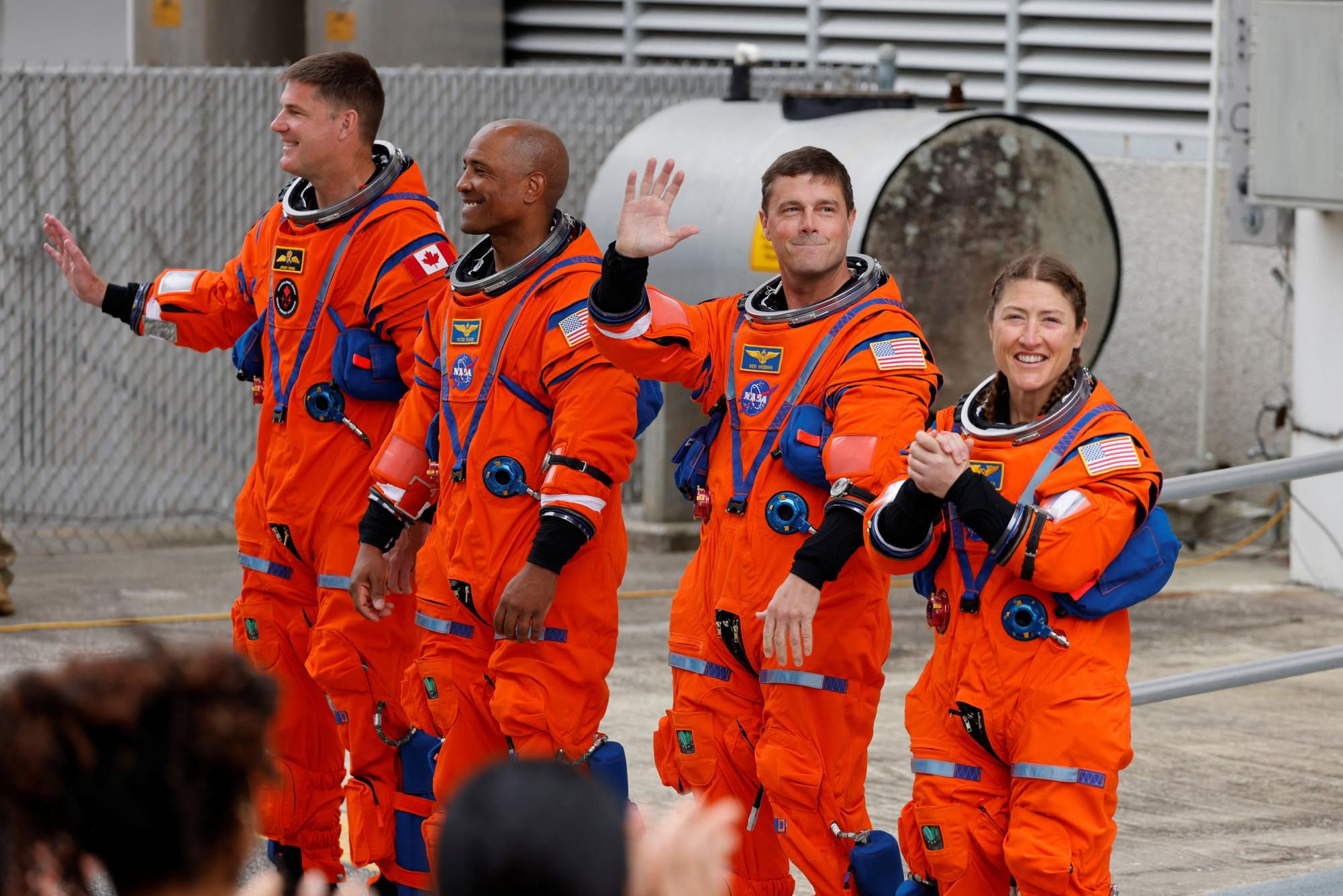
On April 1, NASA sent four astronauts into space on a journey to the far side of the Moon. Orion, the spacecraft that carried the four astronauts, traveled an approximate distance of 695,000 miles from Earth to the Moon and back. The astronauts on board were Commander Reid Wiseman, pilot Victor Glover, mission specialist Christina Koch, and Jeremy Hansen, a Canadian Space Agency astronaut and mission specialist. This journey to the dark side of the Moon was the first in over 50 years, with Apollo 17 being the last journey to the Moon on Dec. 11, 1972. NASA began to discuss the idea of Artemis II in the mid-2000s, with the program officially being established in 2017. The trip was roughly 10 days, with the spacecraft being sent on April 1 and then landing on April 10.
NASA chose to do Artemis II for many reasons, with the main one being to put the Orion spacecraft through a series of tests. The spacecraft was designed to carry the four astronauts beyond low-Earth orbit, having the ability to travel to the Moon and further. Orion was first launched on Dec. 5, 2014, on top of a Delta IV Heavy rocket. While on board, the crew conducted a series of planned tests to evaluate Orion’s systems, procedures, and performance while in deep space. Along with this, the crew practiced mission-critical activities, including trajectory adjustments, communications at lunar distances, and piloting Orion during different phases of flight.
Another reason why Orion was launched for Artemis II is to validate the Space Launch System (SLS) rocket. The SLS rocket is a heavy-lift rocket that has the ability to send different spacecrafts, astronauts, and different-sized cargo in a single launch. On Nov. 16, 2022, the SLS launched Artemis I, a roughly 25-day flight to test the Orion spacecraft as they did during Artemis II, making it the first integrated flight test of NASA’s Deep Space Exploration System. Unlike the Artemis II mission, Artemis I was an uncrewed test mission to see how Orion would perform during deep-space explorations in the future.
The flight path of Artemis II consisted of the initial launch, flying around Earth, flying around to the dark side of the Moon, and flying back. Along with this, the crew did a series of tests and observations while onboard.
Brief of Flight Path:
- On Day 1, Artemis II began to fly around Earth, first in low-Earth orbit and then going into a high elliptical orbit. The crew will conduct a 23-hour checkout of the Orion spacecraft.
- From Day 2 through Day 6, Orion performed a series of different tests and actions, such as a trans-lunar injection burn, a lunar flyby, and conducting both the closest approach to the Moon and the furthest distance from Earth.
- From days 7 to 9, Orion exited the “lunary sphere of influence” and made its way back to Earth.
- On Day 10, Orion performed its last return trajectory correction burn, and the crew on board will prepare for reentry.
On April 10, at 8:07 p.m. EST, Artemis II returned to Earth and landed off the coast of San Diego. Orion was able to surpass the previous distance record of 248,655 miles, belonging to Apollo 13, and gain a new record of 252,756 miles. The total distance Apollo 13 traveled from Earth to the Moon and back was approximately 550,000 miles, with Artemis II’s distance being approximately 695,000, making it the farthest distance a spacecraft has traveled to the Moon and back.